
Why do humans find talking to God, aka prayer, so hard? Could it be shyness or self-sufficiency?

For some people, shame may be keeping them from God because they have doubts or possibly feel like they have done too many bad things.
Whatever the reasons are, none of these things can impede the Creator when He calls us to Himself. God has a passion to dwell with people. He desires to speak with us and is fully able to teach us to communicate (pray) with Him, regardless of the obstacles that we face.
Growing up in the seventies in a secular household was not conducive to learning about faith in God, who He is, what He does, or even prayer. While Christianity was a normal thing to encounter in the culture at that time, and generally tolerated by non-Christians, my family was more earthly-minded than spiritual. I don’t recall any negative attitudes towards prayer or ideas about faith, but we were taught, or more likely caught, that work, education, and being independent were most important. My religious education was in God’s hands alone, and He was very creative with it.
While not a family of faith, we still celebrated holidays such as Thanksgiving, Christmas, and Easter with special meals and gifts. I have a distinct memory of a holiday meal where someone, I don’t know who, said a prayer of thanksgiving.
This single memory made a huge impact. No one in my family can remember this, but I was and am encouraged by this prayer of thanksgiving that was directed towards the Lord.

Because my dad’s side of the family had emigrated from Greece, my mom thought it would be a fun family venture to visit the local Greek Orthodox Church to experience the people and culture. Visiting an Orthodox church touches all the senses. Walking through the grand, heavy wooden doors, one is greeted by the amber glow of assorted-shaped candles and the ancient storytelling of Byzantine iconography. Copious amounts of incense blanketed all available oxygen, and censer bells tinkled, setting a definite somber mood.
My four siblings and I were directed to Sunday school classes, and we tried our best to follow along as the class recited the Lord’s prayer in Greek. Even though I did not understand all that was being taught, the Lord used this experience to plant seeds regarding His existence and His desire to talk with me. He would water the seeds over time.
Public schools in the seventies had no problem teaching about world religions, and our fourth-grade class was assigned a project to research and make a report.

Reading the colorful books, with their shiny pictures of relics, and summaries was fun for me, and I truly enjoyed drawing pages of symbols for my report. This study taught me the basic doctrines of each major world religion, and, by default, taught that spirituality was to be embraced and that it was good. Drawing the cross for the Christian section was particularly enjoyable to me. I probably couldn’t have explained why, but the hidden hand of God was at work.
I love how Almighty God uses all kinds of resources to teach us. In my life, he has used people, experiences, movies, and even secular, banned books. Watching Cecil B.DeMille’s epic The Ten Commandments instilled in me the idea that the God of Heaven talks to humans. His interactions with Moses were unforgettable to me. In the Bible book of Exodus, chapter three, there is an amazing encounter between God and Moses. Moses asks God how to answer the people when they ask Moses for God’s name. God answers in verse fourteen, “Say this to the people of Israel, ‘I AM has sent me to you’.”
As a young girl, the concept that God desires to be in a relationship with “His People” was very important and would bear much fruit later when He was calling to me.

During elementary school, I had another experience with Moses’s God when my best friend, Abbey, invited me to join her in celebrating her Bat Mitzvah. This is a ceremony for Jewish girls turning twelve. They are considered adult women at this age and are responsible for living as such. Experiencing Abbey reciting her prayers to God in Hebrew at the Synagogue was very serious and beautiful.
She had a big party and received lots of gifts and attention. God had sown another seed in my heart for Jewish people, their feasts, and His kingdom.
In my preteen years, I read a book titled Are You There God? It’s Me, Margaret by the prolific, and sometimes controversial author, Judy Blume. Judy’s main character, eleven-year-old Margaret Simon, and I had a lot in common. We both came from irreligious families of origin, had friends who either attended church or synagogue regularly while we did not, and shared a childlike assumption that God was listening. Looking back, it was a blessing to relate to Margaret as she talked to God about important things in her life: boys, bras, and whether or not to join the girls’ club. Margaret was a normal girl who thought about the things I thought about, and she talked (prayed) to God about all of them. Margaret was mostly comfortable as she shared her deepest thoughts with Him. She prayed even when she felt guilty, or sad, or mad. Her prayers were an example for me, and this character set the tone for my later attempts at communicating with God. I think if we had met, we would have been good friends.
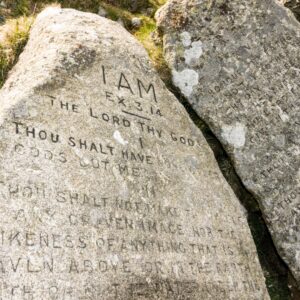
As life moved on, I forgot about I AM, Moses, The Ten Commandments, and the girl that prayed, Margaret Simon. From my mid-teens on, the storms of life erupted. Family members died, my parents divorced, and the family business closed. Properties were sold, people moved, we were all disconnected from each other, and sadly, my thoughts about God went dormant.
As life ensued, I began to suffer panic attacks, nightmares, and agoraphobia. I missed a lot of work and family functions. I had no discernment between good and evil. Looking back, I realize how stubborn I can be. It took a lot of emotional, physical, and spiritual pressure before I decided to turn away from my circumstances and worldly ways of coping, and cry out in prayer to The I AM who talked to Moses, and who was waiting patiently to meet with me. The Lord brought to my memory the idea of prayer by reminding me that Margaret Simon talked to God about everything.
I prayed for the first time, “Are You there, God?
It’s me, Amy.” I was 24.

Shortly after, I was given a Bible by my grandmother. My mother, who wasn’t a Believer at the time, but is now, had given it to her as a gift. The print had become too small for Grandma, so she gave it to me. I love God’s sense of humor. I read that Bible so much that the cover fell off. I had it recovered, and I read it so much that it fell off again. In that book, I learned that God loves humans and wants to communicate with us about Himself, His plans, and our future.
From the beginning of the Bible in Genesis, we see God creating humans, Adam and Eve, and talking and walking with them. The Lord visited Abraham and shared a meal with him. Conversations between God and people are documented throughout the biblical texts. In the Old Testament, we read about God’s encounters with Elijah, King David, and Solomon, while in the New Testament, we see God come to earth. The Lord Jesus has no problem conversing with men, women, and children. He even speaks with His enemies: Judas, Pontius Pilate, and those who eventually kill him. Before His ascension, Jesus told his followers that he would come back and bring them to Himself, but in the meantime, He would send His Spirit to reside with them. Why? To guide them, teach them, to correct them, all by speaking with them.
Since the time of creation, God has always wanted to dwell with and be in a relationship with humans. Dwelling with someone includes talking. He wants to talk and listen to you. If you don’t know what to say, start with this: “Are you there God? It’s me, (insert your name).” He will guide you through the rest.
— Amy Shatrick for The Sublime Soiree (c) October 13, 2025